
Maths intervention that meets pupils where they are.
A modular programme that builds the understanding and confidence pupils need to move forward, designed for those with gaps in their mathematical foundations.

1 · What schools tell us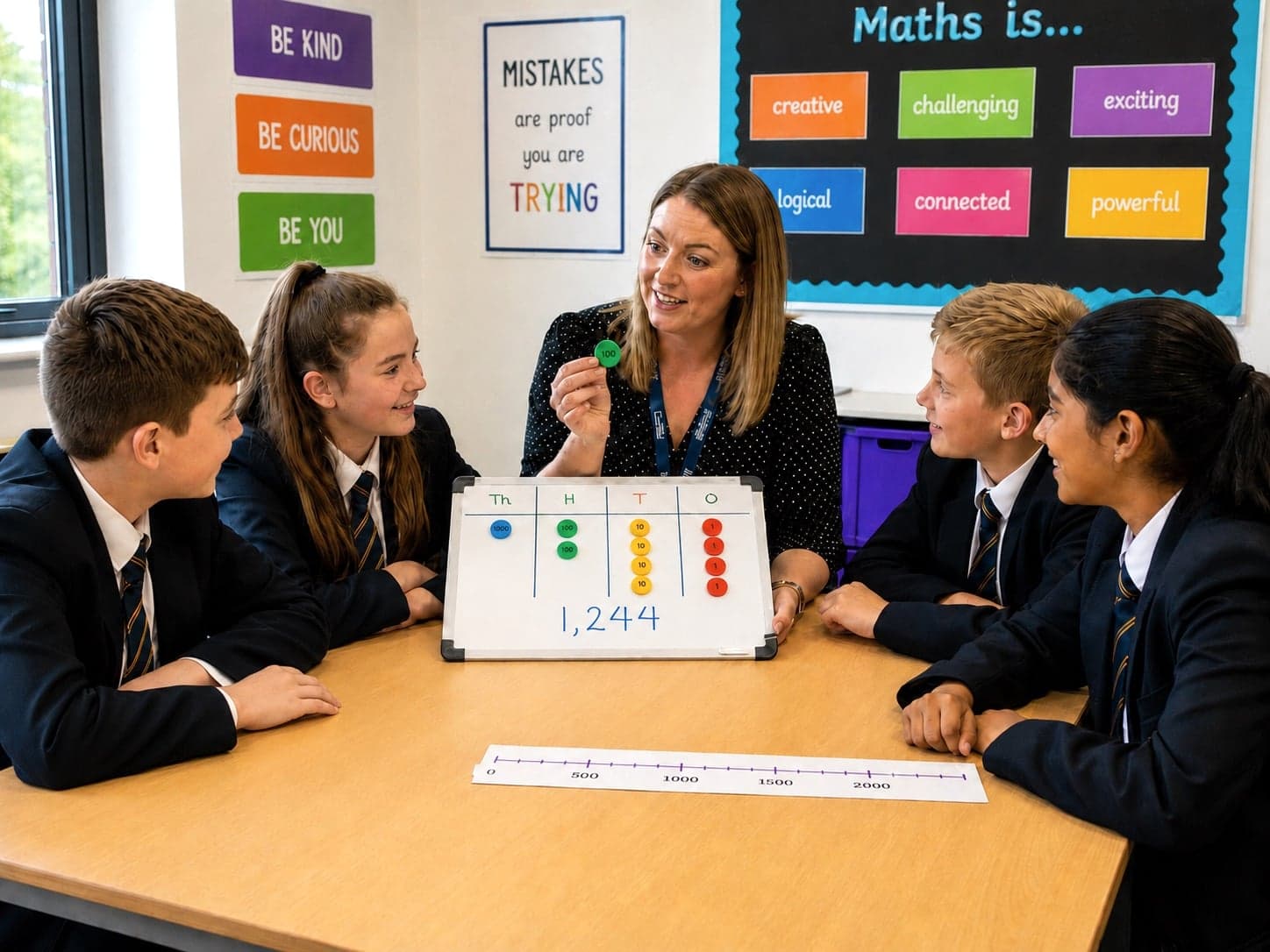
A familiar picture, in every classroom.
Many schools are dealing with the same picture. In a typical class there is a wide range of prior understanding, with a significant gap between the highest and lowest attainers. It makes the job of teaching harder, and the pupils who struggle most are often the ones whose needs are hardest to meet inside the lesson. To support these pupils, schools often arrange intervention during the lesson or outside it, usually led by a teaching assistant. It is a real commitment of time and care, and schools want the most from it.
We've built Groundwork Maths to help you solve this problem. The free diagnostic checks help teachers and teaching assistants identify where pupils' foundations need work. The Groundwork Maths teaching programme then provides the structured resources and support to close those gaps.
2 · What is Groundwork Maths?
Built around the gaps that hold pupils back.
A modular programme, structured so pupils only do what they need.
1
We've taken the strands of the Ready-to-Progress criteria as the starting point for the programme. Six strands, covering the foundations of maths.
2
Each strand is divided into a series of sequential phases. Each phase covers a key area of foundational maths understanding.
3
Each phase is split into modules, with each module focused on a specific area pupils may be struggling with, such as rounding to the nearest 10, 100 and 1,000.
4
Each module is made up of ten sessions. The sessions move forward in tiny steps, deliberately. Pupils who have struggled with a topic before benefit from a different approach, not prior content simply repeated.
5
Sessions are designed to be delivered by a specialist or non-specialist, following the provided session plans. Schools can choose between 20- and 60-minute sessions.
6
Each module comes with its own printed teaching pack, giving the adult everything they need to deliver the sessions whether the work is happening inside or outside the classroom.
3 · The principles behind every session
Mental models, micro steps, and talk.
We've built Groundwork Maths on a simple idea. Pupils who struggle with maths are usually missing the mental models and the language to make sense of it. Groundwork gives them both, session by session, in a way that is structured yet flexible enough to be used where each pupil needs it.
1
Mental models pupils can trust
Many pupils who struggle with maths have no mental images they can draw on. Groundwork Maths builds those images. Every session uses a clear visual representation of the maths, and every session includes a moment of visualisation, so pupils carry the picture with them into their written and mental work.
2
Micro steps, secure progress
Each module is made up of ten sessions, and between one session and the next only a small part changes. Pupils are not asked to hold too many new ideas at once. The progression is gentle but purposeful, and because the steps are micro, pupils can feel their own progress.
3
A space to talk about the maths
Mathematics is a language, and pupils need to hear it and speak it to learn it. In every session pupils say the key mathematical sentence aloud, and they talk with a partner about what they see. The structure gives them the words, and the talk gives them the confidence to use them.
4 · A 4-part session.
A calm, predictable routine.
The same 4-part routine is repeated each session, so the cognitive load stays on the maths.
5 · The session pages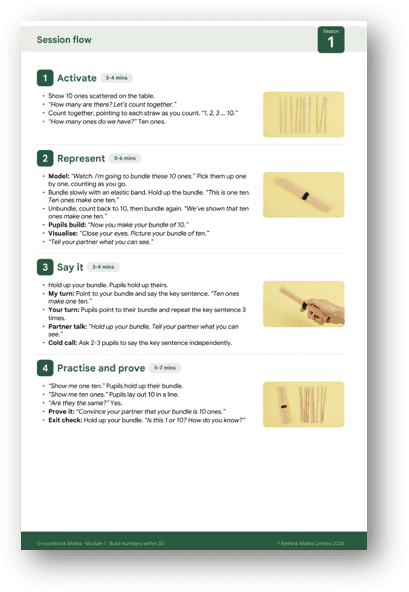
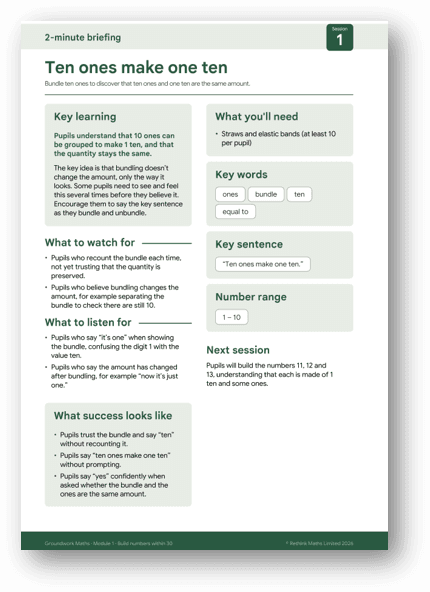
A two-page overview for every session.
Every session has a two-page overview in the teaching pack. The first page is a two-minute briefing for the adult delivering, giving them everything they need to prepare quickly. The second page is the session flow, a glance-at-while-delivering prompt organised by the four phases of the session.
The pages give clear guidance, including what to watch for, what to listen for, and what success looks like. They offer the key mathematical sentence pupils will rehearse, and the questions worth asking. The structure is directed enough to give confidence to any adult delivering, and flexible enough to leave room for professional judgement in the moment.
6 · The programme
Explore the strands and modules.
Below are the six strands of Groundwork Maths. Browse a few sample modules to see what they cover. The full programme overview is on the programme page.
NPV
Number & place value
4 phases
NF
Number facts
4 phases
A&S
Addition & subtraction
4 phases
M&D
Multiplication & division
4 phases
FR
Fractions
4 phases
GE
Geometry
4 phases
Browse a few sample modules below. Tap any card to see its ten sessions.
- Ten ones make one ten
- Build 11 - 13
- Build 14 - 17
- Build 18 - 19
- All the teen numbers
- Introduce 20
- Build 21 - 25
- Build 26 - 29
- Digit values 11 - 29
- Fluency to 29
- Subitise on a 5 frame
- Parts on a 5 frame
- Bonds to 5
- 5 frames to part-whole models
- Secure bonds to 5
- Introduce a 10 frame
- Bonds to 6
- Bonds to 7
- Bonds to 6 and 7
- Bonds 5 - 7
- Add on the place value grid
- Record in columns
- Exchange the ones
- Exchange the tens
- Exchange ones and tens
- Exchange the hundreds
- Column addition without equipment
- Add 3-digit and 2-digit numbers
- Missing digits
- Column addition in contexts
- Read an array
- Make an array
- Write the multiplication
- Find the total of an array
- Draw an array
- Find the total from a multiplication
- Multiplication for groups
- Multiplication in contexts
- Multiplication on jumps and bars
- Fluency with multiplication
- One part shaded
- More than one part shaded
- Write halves, thirds and quarters
- Write fifths, eighths and tenths
- Numerator and denominator
- Write non-unit fractions
- Read fractions from a picture
- Draw fractions from a name
- Read and write any fraction
- Fluency with fraction notation
See the full strand on the programme pageEvery module in this strand is listed on the programme page. Its Phase Packs can be ordered now, with each pack's delivery window shown on the pricing page.
7 · How it fits in the day
Two formats, one programme.
Schools choose the format that fits each pupil and the timetable. Pupils can move between the two as their needs change.
20-minute format
Daily, alongside the class lesson
Short daily sessions delivered outside the lesson, usually in an existing intervention slot. Suits pupils with specific gaps who can mostly access the class lesson.
60-minute format
During the lesson, in or out of class
Longer sessions delivered during the lesson itself, for pupils who need more time on foundational work or who are working with an adult on content matched to where they are.
8 · Three layers of support
Identify. Teach. Grow.
Running a maths intervention well is harder than it looks. Finding the right pupils, training the team, keeping it going across a busy year, schools tell us all the time how much there is to hold together.
Phase Packs are sold separately. Layer on whichever level of support fits your school, from a single setup call right through to a full year alongside our team.
Tier 1 · £80
Identify
A focused setup call
For confident teams who just want help planning a strong start.
45-min Impact Lead callReview diagnosticsPlan first half-term
See what's includedTier 2 · £250
Identify + Teach
Setup, plus a year of training
For teams newer to structured maths intervention.
Everything in IdentifyUnlimited webinarsOn-demand library
See what's includedTier 3 · £1,500
Identify + Teach + Grow
A year with our team alongside you
For schools embedding the programme deeply. England only at launch.
Everything in TeachAssigned Impact LeadUp to 3 fidelity visits
See what's included10 · Inclusive Mainstream Fund
Groundwork Maths and the Inclusive Mainstream Fund.
From the 2026 to 2027 academic year, every mainstream school in England receives a share of the Department for Education's new Inclusive Mainstream Fund. The fund is designed to help schools support pupils with additional needs in mainstream settings, with guidance that prioritises early, targeted, evidence-based support.
The DfE's best-practice guidance sets out clear expectations for how schools should respond. Groundwork Maths is built around the same principles.
Early, evidence-based support
Effective small-group and one-to-one interventions to remove ongoing barriers to learning, implemented with fidelity.— DfE best-practice guidance
Groundwork Maths is a small-group intervention built around Ready-to-Progress criteria, with clear guidance for every session and a consistent structure that supports fidelity of delivery.
Teaching assistants deployed with purpose
Deploying teaching assistants in line with best practice to help pupils with additional needs develop independent learning skills.— DfE best-practice guidance
Groundwork Maths is designed to be delivered by a teaching assistant or a teacher, with session cards written to support the adult in the room and build pupils' confidence to work independently.
Staff trained to deliver
Teaching assistant training, time and resources to support delivery of programmes.— DfE permitted uses of the fund
Groundwork's CPD, resources, and ongoing support are designed to sit inside this provision.
Schools can read the full DfE guidance on the Inclusive Mainstream Fund at GOV.UK.
See where the gaps are. Close them with the right teaching.
Start with the free assessments to see exactly where each pupil's gaps sit. Then pick the modules that match, grouped into Phase Packs you can buy as you need them.
Free assessmentsShort Check and Diagnose assessments built on the RTP criteria. Free to download. Use with a class, then one to one.
One-off purchasePay once for each Phase Pack you need. No subscriptions, no per-pupil fees, no renewals.
Built for adults to deliverPrinted teaching guides with session pages, supporting resources, and worksheet masters. Ready to use.